
The summer of 2026 is once again showing how extreme heat, drought and wildfire risk can affect communities and tourism destinations across Europe. Scientific evidence increasingly links the worsening conditions that favour extreme fires to human-caused climate change, reinforcing the need for prevention, preparedness and cooperation.
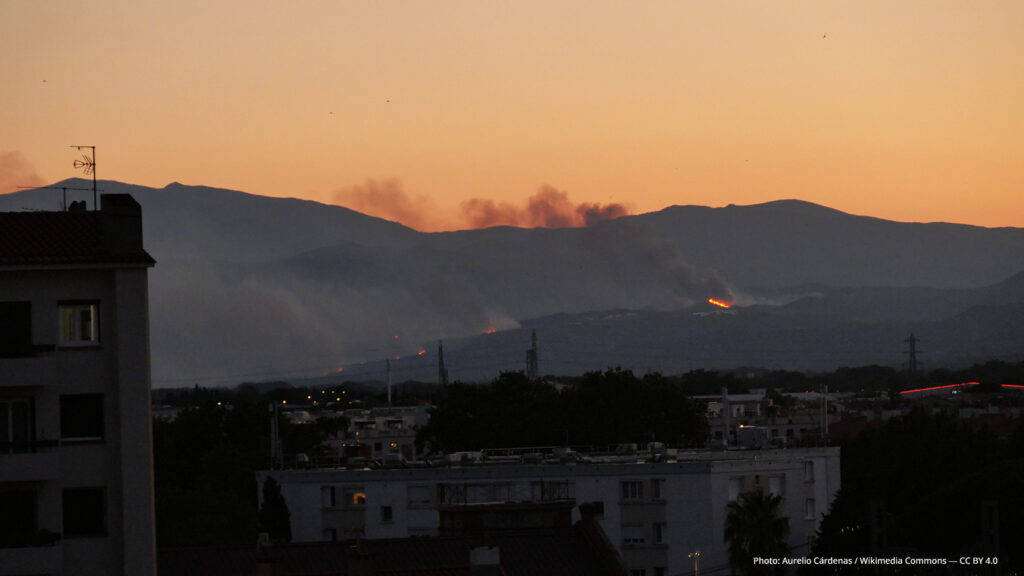
Wildfires have become one of the most visible manifestations of the climate risks facing Europe this summer. Major fires have affected Spain, France and Greece, while other countries have also experienced fires or very high fire danger as successive heatwaves and widespread dryness have spread across the continent.
Data from the European Forest Fire Information System (EFFIS), managed through the European Commission’s Joint Research Centre and Copernicus Emergency Management Service, show the scale of the challenge. By 22 July 2026, 254,388 hectares had burned in the European Union and 1,254 fires had been detected. The number of fires was already more than twice the long-term average for that point in the year, while the burned area was above the twenty-year average, although still slightly below the exceptional figures recorded in 2025.
The consequences have required considerable European cooperation. On 27 July, the EU Civil Protection Mechanism was supporting France and Spain with aircraft, helicopters, firefighters and vehicles after wildfires led to one of Europe’s largest evacuation operations, affecting more than 300,000 people across the two countries. Copernicus satellite mapping was also activated to support emergency teams on the ground.
What does climate change have to do with wildfires?
Wildfires are complex events. An ignition can result from human activity, infrastructure, lightning or other causes, and factors such as vegetation management and land use strongly influence how a fire develops. It would therefore be inaccurate to say that climate change directly causes every wildfire.
What the scientific evidence increasingly shows, however, is that human-caused climate change is making the weather conditions in which extreme fires can develop more likely and more severe.
Western Europe experienced its hottest June on record in 2026, according to the World Meteorological Organization and the Copernicus Climate Change Service. Extreme temperatures coincided with widespread dryness and increasingly dry soils, contributing to wildfire activity particularly in the Iberian Peninsula and southern France. Europe has warmed by around 2°C over the past 50 years and remains the fastest-warming continent.
A rapid analysis published by World Weather Attribution on 30 July examined the conditions surrounding the major fires in central Spain and southwestern France. The study found strong trends towards more severe fire weather as global temperatures rise. In central Spain, conditions as extreme as those observed during July 2026 were estimated to be at least 20 times more likely than in a pre-industrial climate, while their severity has increased by around 42%. In southwestern France, comparable conditions were estimated to be at least twice as likely and substantially more intense.
The researchers highlight an additional concern: periods of abundant vegetation growth followed by extreme heat and rapid drying can create large quantities of highly flammable fuel. The combination of heatwaves, low rainfall and declining soil moisture can therefore make fires harder to control once an ignition occurs.
Why this matters for tourism
Wildfires do not only affect forests. They can rapidly become tourism emergencies.
Europe’s peak wildfire season overlaps with the period when many destinations receive their highest number of visitors. This increases exposure precisely when weather conditions may be most dangerous.
Tourists can also face specific vulnerabilities during emergencies. They may be unfamiliar with the geography of the destination, not know evacuation routes or local emergency procedures, face language barriers, or have limited access to trusted local information. The fires in France this summer occurred during peak tourism season, adding complexity to large-scale evacuation operations.
Hotels, campsites, restaurants, tour operators, guides, visitor centres and transport providers can therefore become important links in the local preparedness and communication chain. Their role is not to replace civil protection authorities or emergency services, but to know how to act, where to obtain reliable information, how to communicate with visitors and how to coordinate with the competent authorities.
Fires can also affect tourism long after the immediate emergency has ended. Damage to natural landscapes and infrastructure, temporary closures, poor air quality, transport disruption and perceptions of safety can all influence the recovery of a destination.
From emergency response to preparedness
The European Union is increasingly placing emphasis on this broader approach. In March 2026, the European Commission launched a new integrated framework for wildfire risk management covering prevention, preparedness, response and recovery. For this summer, the EU also established its largest wildfire-response preparation to date, including 777 pre-positioned firefighters from 14 countries, 22 firefighting aircraft and five helicopters.
The message is increasingly clear: effective firefighting remains essential, but resilience cannot depend exclusively on what happens after a fire starts.
Prevention, land management, early warning, communication, training and coordination all need to be strengthened before an emergency occurs.
The RETES approach
This challenge connects directly with the work being developed through RETES – Resilience Enhancement in Tourism through Education and Skills.
Across its pilot areas, RETES is analysing the relationship between tourism ecosystems and disaster risk management structures, bringing together tourism professionals, civil protection actors, local authorities and vocational education and training providers.
The project aims to transform these local experiences and needs into practical training materials, skills development and cooperation models that can help tourism destinations become better prepared for climate-related emergencies.
As wildfire conditions become more challenging across Europe, building tourism resilience increasingly means asking not only how do we respond to the next emergency?, but also:
Are our destinations prepared before it happens?